Learn from Resistance

Do you see any signs of elephants?

Now perhaps this sign was simply to keep other “intelligent” mammals away, or maybe it’s a joke. Either way it IS a warning that this is a special place to be respected. Unfortunately, a sign that simply reminds visitors not to enter, or to be respectful to the space would not likely be as effective as this sign.

Too often we as collaborators, leaders, colleagues, subordinates, and even friends and family don’t learn from resistance. When someone show signs of resistance to a great idea plan or change —our reaction is to simply push our agenda further. We assume they didn’t understand our careful communicated justifications, motivations and planning.

Consider trying to promote a change with a group of just 3:
A – LOVES the change and will help
B – Understands and will do as asked
C – Resists, and does not support


How successful will this change be? On a scale of 1-10, probably a 6 or 7 depending on how critical C’s role is in the change.

The next time you receive resistance, simple try asking questions to understand. Resistors frequently can provide critical inputs to improving plans.

Some examples:

  1. Unanticipated risks that can be mitigated with adjustments to the plan.
  2. Process exceptions that had been missed.
  3. Customer/User expectations that were misunderstood.
  4. Resource impacts that were underestimated.
  5. Identify other priorities that may conflict with the plan.

At a minimum, taking the time to ask the resistor to explain their reaction will give them time to further understand and feel that their perspective is valued and considered. This will greatly influence them shifting from at least a detractor to a follower, and perhaps with the optimal engagement, they’ll even become a promoter of the plan!


Great Meetings Matter

When you bring a diverse group together in an attempt to gain alignment; share ideas; make decisions; set goals; and ultimately gain effective synergy — TOO often the efficiency factor is overlooked.

Key challenges include:
  1. Protocols
  2. Information Alignment
  3. Engagement of Team

1 – Protocols

  • A clear agenda included with the meeting invitation will:
    • Set expectations.
    • Facilitates previous action and decision review.
    • Enable participants to prioritize their participation appropriately.
    • Prompt preliminary conversations to elevate alignment.
  • There is a degree of formality to awesome meetings that someone must own.
    • Who is facilitating the meeting? resolving conflicts? timekeeping?
    • Clear team/organizational decision making process?
    • A Scribe records actions and decisions in a transparent document.
      (OneNote for this)

2 – Information Alignment

  • Do NOT use meetings to share excessive information.
    • This is an expensive approach.
    • Many need time to process new information & ideas.
    • Information overload is a major roadblock to progress: actions & decisions.
  • DO send information in advance for participants to consume, process and consider.
    • Send access to information with meeting invitations.
    • Ensure a respectable amount of time prior to the meeting.
    • Set the expectation that all participants will have reviewed the information.

3 – Engagement of Team

  • Protocols and Information Alignment lay the foundation.
  • Effective meeting facilitation then drives team engagement
    • Sticking to the agenda (mostly)
    • Encouraging radical candor from all
    • Smoothing conflict
    • Clarifying unclear or incomplete issues
    • Asking questions to elevate alignment
  • Striking the right cultural balance of professional, formal and even fun.

FOOTNOTE: Of course with the major shift to virtual meetings there are additional challenges. With the right protocols virtual meetings can be more efficient – with mastery of the technology.

Looking Ahead— Let’s Try 30/60/90 in 2021


2020 was…. well, a year many want to forget.
The reality is that 2021 will likely be equally challenging, perhaps in different ways.

So, what can any of us do to thrive in despite all these challenges?

  • Covid-19 virus
  • Joblessness
  • Quarantine Chaos
  • Economic challenges
  • Diversity / Equity
  • Political dynamics
  • Remote School
  • Remote Work
  • Media and information overload

Traditionally we make ‘New Year Resolutions’.
Lose weight, Exercise, Quit a bad habit…
Statistically, only about 7% of people stick with their resolutions!

With “2020 hindsight” (yeah, that joke is already old!)
let’s try a different approach: a 30-60-90 outlook.

Here’s how:
  1. PARTNER with someone or form a small group.
    This is critical – you’ll all keep each other honest, just by sharing socially!
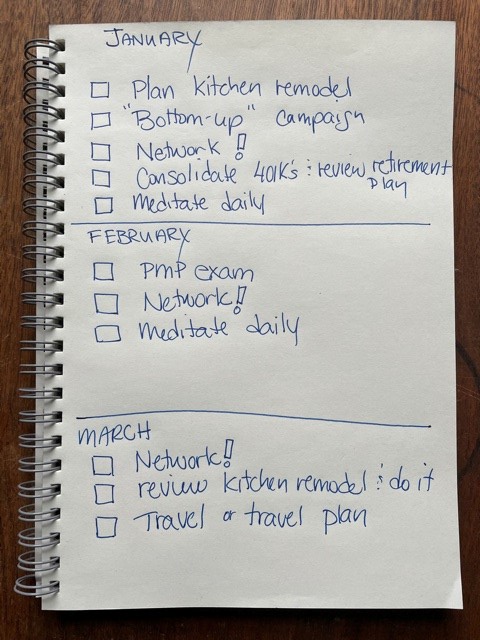
  2. MONTH 1: Individually or together, spend just 30-60 minutes to outline what you want to focus on in three buckets: one for each of the next 3 months, here’s an example:
  3. ONGOING: Share and discuss your list with others openly. The more you share the more committed you will naturally be.
  4. MONTHLY: Try to formally ‘touch base’ with your partner/group. Share status, feedback and advice. Update for the next 30-60-90.
  5. NEW YEAR: Celebrate successes & lessons learned. Find ways to refresh your focus!

DON’T overthink this.
DON’T make it a ‘to do list’. It’s a forward-thinking focus list.
DON’T think of it as an additional thing to do.
DON’T stress when you don’t check all the boxes. Just reevaluate and update the list.
DO include personal and professional.
DO challenge yourself.
DO feel proud when you check off a box!
DO encourage each other!
AND, even try to make it FUN!

NOTE: This can be done with kids, coworkers, friends, even parents. It can be done face to face, on social media (start a private Facebook or LinkedIn group), and even virtually with Zoom or Teams (or whatever tool you’re comfortable with)!