A CASE STUDY IN REAL COLLABORATION
A global manufacturing company faced a critical ERP project; migrating from a 10-year old tool to a modern cloud solution…a huge leap! The team first focused on learning features and functions of the new tool and refreshing themselves on current best practices. Before proceeding to process discovery with their contracted ERP consultants they were determined to align on current processes to take advantage of this ERP investment. Additionally, they were also preparing to scale up production to meet accelerating demand making supply chain optimization critical.
This case study triggered the formalization of the “SMapping” process that Real Collaboration Rocks LLC will leverage with any partner to elevate engagement, understanding and continuous improvement to any business process. Here are the highlights!
SCENARIO
- Four locations: US (HQ), EU and 2 in APAC
- Project team: global representation from each function area
- Many process conflicts: known and unknown/assumed
- Legitimate local process variation needs
- Inconsistent documentation
- Communication challenges: language, time zone, cultures
OBJECTIVES
These were the key objectives, but they were clearly a subset for the full ERP migration project.
- Expose gaps and conflicts between local processes.
- Elevate understanding and appreciation of each location’s and function’s process needs.
- Discover common ground and build global alignment.
- Drive towards standardized processes and work instruction approach.
ACTION PLAN
This plan was outlined, communicated, and executed.
- Define a clear list of processes, with prioritization.
- Develop a standardized, simple approach to document current state.
- Train each local group to map and document the current state.
- Plan a global event to share and align on critical processes.
- Prepare for process discovery with ERP consultants.
OUTCOMES & DELIVERABLES
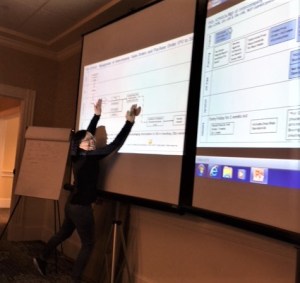
- Key staff in each location was trained to collaboratively generate process maps with stakeholders, and then digitized them for review and iteration.
- The finalized process maps created a globally harmonized resource that was leveraged throughout the project as a vital resource.
- A Global Team Summit was conducted to share the process maps:
- Maps projected side by side to compare & contrast.
- Local Process Owners clarified as needed.
- Facilitated discussion to find alignment and global approach.
- Target states were carefully agreed to and documented.
- Functional ERP consultants attended
- A significant reduction in the consultant expense was realized during the process discovery phase because this pre-work was already completed without the consultants.
REFLECTIONS
• More time is always a wish. With more lead time the maps could have been more thorough and more complete.
• The approach was enlightening for the whole team. New perspectives all around – globally and cross-functionally.
• The Team Summit was the first time for many global teammates to meet each other.
• Reflecting on the entire project, the team building component of this event was equally important as the process work.
• These process maps were a point of reference for the life of the project, internally and with vendors.
With this primarily internal project effort came significant consulting expense savings; strengthened process accountability and ownership; and the continuous improvement cycle was jump started. This would prove mission critical for the rest of the ERP migration project and beyond.
 Real Collaboration Rocks LLC